Monday, January 21, 2013

Social Narratives

I have just competed the Social Narratives Module from autisminternetmodules.org. Such a great learning tool! I wanted to share a bit of what I learned but I STRONGLY recommend you check out the modules yourself.

A daily challenge for Individuals with Autism Spectrum Disorder (ASD) may be difficulty with social interactions. Social narratives are designed by parents and educators to help enhance social functioning for individuals with ASD.  Social narratives are visually represented stories that describe social situations and socially appropriate responses or behaviors to help individuals with ASD acquire and use appropriate social skills.
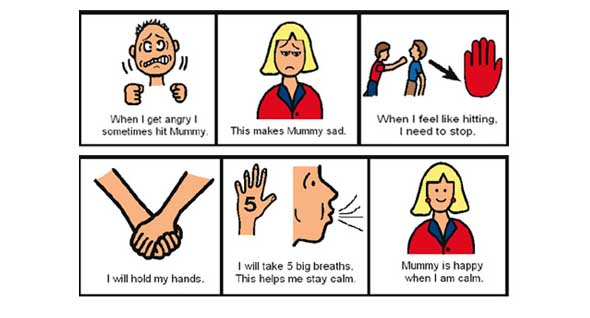
Image Source: speechbuddy.com
Social skills include communication, problem-solving, decision-making, self-management, and peer relations abilities.

When can social narratives be used?
-after a social "error" has occurred (making a rude comment to a peer, hitting, scratching)
-before a new experience or transition (going to get a hair cut, changing schools, meeting a new teacher)
-as an intervention to reduce an already reoccurring behaviour (interrupting classmates, shouting out in class, picking nose)

The module lists specific steps which must be taken to ensure a social narrative is effective.  A neat way to create a social narrative is using PowerPoint and depending on the individuals needs you can add speech so that along with reasing the story, the individual can hear the story.

As part of my placement at REACH, my supervisor said we will will be creating some social stories for a few clients. Looking forward to learning more about social stories and creating some of my own!

Friday, January 18, 2013

Autism Internet Modules

Today, I was introduced to a great resource for anyone working with indivduals with autism. It is was Autism Internet Module and can be found at: http://www.autisminternetmodules.org/

Once you create an account, you can access information for free, under various categories such as: Recognizing Autism, Infants and Toddlers with Autism, Autism at Home, Autism in the Classroom, autism in the Community and Autism in teh Workplace.  Each category has several online workshops that range from an hour to two hours.

This is a great resource for any one working with indivduals with autims or even for parents of children with Autims. The best part conent is FREE. You can buy credits to print certficates if you choose.

I am looking forwad to completing some of the modules :)

Tuesday, January 15, 2013

Guided Observation: Intensive Behaviour Intervention

Today, I had the opportunity to do a guided observation during a Intensive Behaviour Intervention. Commonly referred to as IBI, Intensive Behaviour Interventions are described as the application of ABA principals in an intensive setting (minimum 25 hour per week) with goal of seeing a change or improvement in behaviour.

KidsAbility describes IBI using the following criteria:
  • Uses systematic behavioural teaching methods
  • Has clearly defined strategies & goals;
  • Is individualized to the needs of each child
  • Incorporates changes based upon direct measurement of each child's learning'
  • Teaches children one-on-one or in small groups.

It was really NEAT to finally see an IBI session in person after reading so much about it the last few months. Wow, do Instructor Therapists (IT) work hard! The session that I observed was with a individual who I will call "Simon". Simon was a active little boy with a lot of sensory issues. he loved to pinch because he enjoyed the sensation, as a strategy, the IT used a squishy pillow. Simon's behaviour was reinforced when Simon squeezed the pillow.

"Simon" was non-verbal so he used PECS (Picture Exchange Communication System)  and approximations as his functional communication system. Examples of some of the behaviours that were being reinforced were eye contact, sitting in his chair and squeezing his pillow toy. Some of the skills being taught were related to identifying pictures of family members, identifying colours and identifying body parts. It was really interesting to watch but a bit overwhelming as well. So much to learn!

I am hoping to see a couple more sessions before the end of my placement at REACH.

Autism Spectrum Disorder (ASD), Special Education, Placement, Intensive Behaviour Interventions

Friday, September 7, 2012

Autism and Behaviour Science

This week I am starting a post grad Certificate in Autism and Behaviour Sciences. It is an online course through Algonquin College. I have taken online courses before, but never full-time  so I am not sure exactly what to expect. I think I will miss face-to-face interactions. That was one of my favorite parts of the past year, taking my Bachelors of Education (and undergrad).

First semester I will be taking five courses including:
  • Autism - Introduction to Applied Spectrum Disorder (ASD)
  • Introduction to Applied Behavioural Analysis
  • Parent and Staff Training
  • Working With Families and Teams
  • Ethics and Professionalism
In January I will do a placement for four weeks. There are a few different types of placements which you can have, including ASD Agencies, IBI settings, School Placements and School Support programs.
I am hoping to be in a school setting and I know a few autism classes in the area. I will be exploring my options. There are two placements so I am hoping to have a range of experiences. We have to set up our own placements which is one of the unique challenges for a Distance Ed program.
It is a standard program, so course and expectations are the same at all the schools the program is offered in. I considered going to Mohawk and they seemed to be really great about answering questions, so it is worth looking into if anyone is interested in the program and located in the Hamilton area. Ontario Colleges would have a list of all schools that offer it.

Monday, March 5, 2012

Hands-on Science Robots and Ferris Wheels

As of late, I have been busy finishing my courses at Brock and planning for my placement in a grade eight classroom so I have not had much time to post. I'm not neglecting you!

Today, one of the grade eights made this great robot out of Lego that I wanted to share. It walks backwards and forwards using gears and a battery pack. Very cool! He could even make it dance. Mr. Roboto here was made just for fun after one student completed the given task.


 It was amazing to see what the students came up with given an open ended task during the systems in action unit in science. Students were asked to use Lego to create a carnival ride using gears and pulleys. Hands on learning is a really powerful experience for both students and teachers. The students were engaged and learning through problem solving. It was amazing to see what students could come up with. Each was unique and different in their own way. I will share more pictures of the final products if I can get a hold of them. Inspiring!

All Hands in.


Wednesday, January 25, 2012

My Leadership Philosophy

Personal Philosophy
For the last few weeks, I have been considering my own personal leadership philosophy. I think my personal philosophy aligns most closely with Participative Leadership. It is important to me that the decision making processes of the group are considered and valued. By engaging all stakeholders in the decision making process, I believe it increases the school effectiveness. This approach gives members of a school community ownership and pride in the school, helping to create a better place for learning to take place.

Making it Meaningful
I have been working on creating my own personal mission statement. I wanted to ensure that my mission statemnet really meant something to me and that it was both authentic and meaningful. It was important for me to remind myself when creating this that it needed to include specific actions that I will take. I need to decide exactly what to do in order to work towards accomplishing my goals. The following is my working mission statement. I have chosen to share it because I think that makes me more accountable.

Personal Mission Statement:
"As a edtech teacher leader I seek to use the participative/distributed approach to leadership because I value the input of all stakeholders. I will support the development of the organization by fostering collaborative processes through social networking sites, specifically those with a focus on education. I will work on modeling a positive attitude to aid in promoting an enjoyable and productive work environment and school culture. In the classroom, I will try varied methods of delivering instruction with a focus on technology integration. I will reflect upon and share these experiences with my colleagues both in the school setting and online using my blog and other social media outlets. I will adapt my practice in response to feedback received as a result of these reflections"

I am open to suggestions and comments, please feel free to share!

Monday, January 23, 2012

In our cohort class we looked at case study 11.1, called "The Discouraging Grade" from the book, Case Studies:
This case study was found on page 87-88.

Case study resources:

Differentiation-Teaching, Learning and Leadership
http://www.scoop.it/t/differentiation-teaching-learning-leadership

Survive and Thrive-  Virtual Conference for Begging Teachers
http://www.survivethrive.on.ca/

Teacher Relationships